
A Substack in a bottle: my experience on this platform after one year and sixty-four pieces

Today marks the first anniversary of my Substack, which I finally started last September after procrastinating for a few years.
Back then, when I created this space to explore the history of videogame RPGs, I didn't imagine I would end up writing some sixty-four pieces during its first year, covering a variety of titles developed in different decades, countries and subgenres on a wide array of platforms, ranging from obscure Japanese home PC RPGs like Digan no Maseki or Progenitor to forgotten Korean classics like Arcturus, ambitious American hybrids like Birthright: The Gorgon’s Alliance, imaginative Russian sci-fi CRPGs like Hard to be a God, Italian proto-gamebook RPGs like Profezia or Indonesian takes on the mecha tactical RPG subgenre like Kriegsfront, not to mention a number of retrospectives about RPG artists and character designers, a three-part history of French RPGs and some op-eds.
While my publication is still decidedly niche compared to many gaming Substacks, something I expected given the themes I focus on, I'm still humbled to see how my readership has doubled since early June, and I’m deeply thankful to all the readers who followed my journey into RPG history. What is more, I had a lot of fun and, given how much I missed discussing RPGs after I stopped writing on magazines years ago, my only regret is not having started out sooner.
Then again, this little journey of mine did have a number of hurdles, some of which I had envisioned since the beginning, while others came as unexpected twists I had to adapt to.
-DISREGARDING POSITIONING
Writing about videogame RPG history means accepting your audience will be a niche of a niche, and, counterintuitively, this is even more true if you aim at covering the RPG family without limiting yourself to a single country or subgenre. Videogame RPG fans, after all, have long suffered a divide between those invested in Western and Japanese titles, with those interested in pursuing both often separating their activities between different communities and websites rather than going for a syncretistic approach able to highlight their crosspollinations and shared history, something I always tried to do both as an hobbyst in the communities I participated in and as a writer when I had the pleasure to contribute to my country’s videogame magazines.
While for a variety of reasons (which, in fact, would deserve their own piece) this divide is far less of an issue nowadays than, say, in the late ‘00s and early ‘10s, it’s still an undercurrent in most communities, which in turns creates a self-perpetuating cycle where those interested in videogame RPG history and critique tend to grow as hobbysts by only focusing on a narrow subset of titles and franchises, rather than exploring RPGs by following an holistic framework, something I touched upon in my very first post when I introduced my personal guidelines and discussed the issues with many attempts to define videogame RPGs in an exclusionary way.

In this regard, purely in terms of brand positioning, I knew from the start it would be much easier to build an audience by covering only a single strand of the RPG family, like Western or Japanese RPGs, possibly laser-focusing on subgenres with a sizeable following like tactical RPGs, instead of jumping between different decades, countries, platforms and subgenres, something that is bound to disorient or even push away those only interested in a subset of the broader discussion about RPG history. In fact, in the past year I’ve seen people subscribing after liking a retrospective about a Japanese RPG only to drop their subscription when the next piece was about a Western game, and vice versa, and I say this not as a rebuke but just as an observation.
Then again, it’s my firm belief that, as difficult as this path may be, it’s also the only one I really want to pursue and, since I’m content with having a smaller, dedicated audience, nor do I plan to monetize this space, mantaining a thematic coherence easily trumps any consideration about building a brand with a more definite identity. In fact, I hope my “brand”, so to speak, ends up being characterized by the unabashed willingness to treat RPG as a cultural phenomenon whose countless diverse facets all deserve to be analyzed and discussed as parts of a bigger whole. Also, it’s way more fun to stay true to your inner drive.
-A SUBSTACK IN A BOTTLE

With that said, what I didn’t imagine was that my Substack experience for the first four months or so would be akin to a RPG-obsessed castaway writing countless messages in a bottle and throwing them into the indifferent ocean, hoping someone would end up engaging with them later on.
Don’t misunderstand me: I really like Substack as a concept, since empowering writers in this day and age sounds exactly the kind of Don Quixote-sque mission someone who has witnessed firsthand the collapse of his country’s videogame magazines couldn’t help but love, and the fact I can just focus on writing my pieces without having to tackle some sort of cumbersome interface (any reference to the Block system is absolutely intentional) is just lovely.
Then again, for a platform ostensibly built to foster long-form pieces, many of Substack’s inner workings seem to push in the opposite direction: I wish I had knew since the beginning how a new writer risks being almost invisible if they don’t use Notes, Substack’s in-built social media-style platform that, while providing a useful venue for short-form contents and musings, isn’t just a side dish to add flavor to your pieces, but is basically mandatory if you want to build an audience.
In fact, while in the first few months I got most of my subscribers from re-publishing my pieces on platforms like Reddit while linking to my page, Substack itself provided a negligible amount of interactions until I started consistently engaging with Notes, and this is while I was consistently publishing one or two pieces per week. After a while, I actually ended up appreciating how Notes let me connect with other writers and with my readership, but I still question their outsized role.
While the way the Substack algorythm works seems to end up favoring already established writers, making newcomers feel like a vox clamantis in deserto, and its overreliance on Notes means you can’t really focus solely on writing regular features if you plan to find an audience on Substack, there’s yet another hurdle that has been widely discussed by gaming-related writers, namely having to present our work by using categories that are only loosely related to it.
Not having a dedicated videogame publishing category despite the size and economic relevance of this industry (I won’t even go into the cultural relevance of this medium, since I accept this is unfortunately irrelevant to most decision-makers) means the budding community of writers and readers interesred in those subjects end up having an hard time finding each other, and the way Substack has ignored the request about introducing it is even more puzzling once you consider how there’s a videogame sub-category under Culture, albeit only for readers and, allegedly, how a videogame category is already available just for your Podcasts.
All those issues, sadly, seems like a byproduct of the classic mix of overreach and feature creep, where a platform initially focused on a specific kind of contents tries to become yet another “everything app” by emphasizing social interactions, doom-scrolling and other media while neglecting its core business. While like-minded writers have learned to cope with those issues by fostering a community in order to spotlight other authors and help them reach their audience, like with
’s awesome Reconnect initiative, I really hope Substack doesn’t end up as yet another platform that, by trying too hard to find a place in a mainstream context it was never meant to compete in, ends up disappointing its original target.-LEVELING UP
Putting aside my personal woes with some of Substack’s inner workings, I would also like to discuss some new features I plan to introduce. So far, I’ve mostly focused on single-game retrospectives and reviews, with pieces about RPG artists and fantranslators as some of the other recurring features. In the future, I would like to expand country-specific pieces like the abovementioned three-part article about French RPGs, while also covering the history of subgenres and specific franchises, possibly sinergizing with the retrospectives themselves.
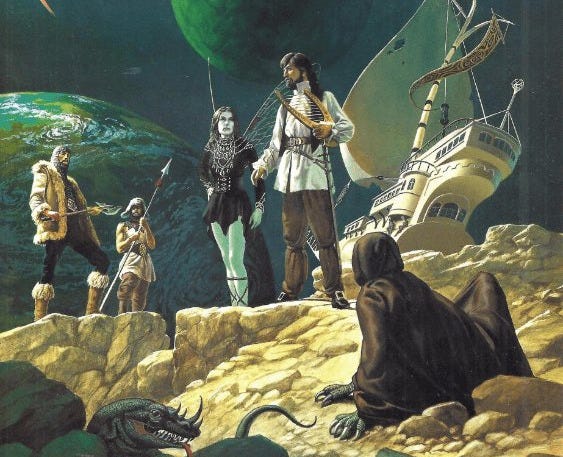
Also, sometimes in the future I would like to introduce a collector-focused feature, Wunderkammer, a continuation of a column I penned years ago on my country’s PSM magazine: stemming for my undying love for collecting videogame RPGs and showcasing their different editions (back in the days, I also had a page on the late Room of Doom website dedicated to that pursuit), this feature will attempt to spotlight a selection of interesting physical editions, building upon their showcase to discuss RPG history in a variety of ways.
-LAST BUT FAR FROM LEAST
A piece discussing this Substack’s first anniversary wouldn’t feel right without an heartfelt expression of gratitude not just for all the readers who hopefully enjoyed some of my pieces, as expressed above, but also to those who supported my work and helped me grow my audience during the “Substack in a bottle” phase.
So, thanks are in order to the moderation staff of the r/JRPG subreddit, particularly VashxShanks and sleepingdragon0, for allowing me promote my Substack there, to
for having supported me early on here on Substack and for his awesome work in reconnecting videogame enthusiasts and, obviously, to all those who engage with my ramblings, like , , , , , , , , and , just to name a few. I really appreciate your kindness, and I hope my upcoming articles will end up leading you to unforeseen places in RPG history yet again!As unimportant as my Substack efforts may be, I would still like to dedicate them to my late Father.
It is an honour for me that you have mentioned me, Magnus! If I am on Substack and have started a niche project about dungeon crawler games in my language, it is thanks to your influence and your work. So I really appreciate your words.
And as for Substack itself, it's pretty disastrous in how it treats video game writers. Especially since it's an industry that moves billions of people... But anyway, I've been writing about video games for many years on both Blogger and Wordpress, so I know what it's like to fight against something that should help you, but only makes things more difficult. Fortunately, I am already at the point where I write, because I simply feel like talking about the things I like, I want to share and, above all, to continue having a hobby that gives me more than just visibility...
Sorry for rambling on, congratulations on these 64 pieces, and let's hope there are many more to come. I look forward to reading all the interesting pieces you have to share.
Greetings from Spain, and as we would say in my language: ¡Nos leemos!
Congrats on the growth! Will be exciting to see what another 12 months brings you!